Showing posts with label Transit - Regional. Show all posts
Showing posts with label Transit - Regional. Show all posts
Thursday, June 2, 2011
Evaluating Transit Station Infill Options
How does the community and transit decision-makers go about selecting from among several viable alternatives for adding infill stations to an existing rapid transit line, in established close-in suburban neighborhoods? To this end, the Public Transit Bug has blogged about tonight's public meeting for CTA Yellow Line Infill Stations and put forth an excellent analysis of the three optional stations being considered, using GIS tools and a dose of common sense. We offer our comments as well.


Tuesday, May 31, 2011
Updated 2035 Chicago Rail Transit Vision Plan
We've updated the 2035 Chicago Rail Transit Vision Plan and included staging plans as well. Emphasis is now given to a new Paris-like RER system of through-routed regional commuter rail. The description text on the Vision pages is not yet in sync with the graphic plan, but we hope to bring these two in alignment soon. In the meantime, feel free to comment.
Tuesday, June 15, 2010
Setting Priorities for South Works
An interesting post by Bob Quellos in Gapers Block on plans for the redevelopment of the former US Steel South Works site on Chicago's South Side, now sitting vacant. The author questions the priorities of the "powers that be" in that city, particularly when faced with massive layoffs in the city services sector.
The project has all the classic overtones of a large Chicago project -- massive spending but with loosely defined priorities and outcomes, little consideration for surrounding neighborhoods (some of the City's poorest), and the specter of impending gentrification.
But Quellos also raises indirectly the larger question of what our priorities should be when faced with myriad challenges, both short-term and structural -- crumbling infrastructure in the rest of the city, continued reliance on non-renewable energy and a sagging economy to name a few. Should we be funneling tax dollars to private investors, and what is the probable outcome if we don't?
 Would South Works (and other sites like it) continue to languish without the injection of private sector investment? And should we be swayed from our long-term goals of neighborhood-strengthening by the need to address short-term calamities, such as the recent layoff of 1,100 CTA employees?
More specifically, what types of investment should we finance in South Works for the greatest positive impact, and what is the time frame for a program of this magnitude to mature? What opportunities avail themselves?
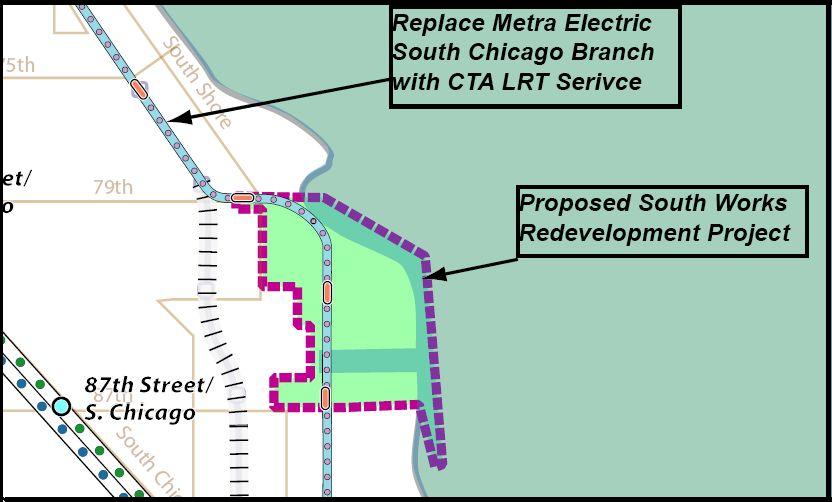
What about high-capacity transit to service the new urban neighborhood? This blog has long advocated a Vision Plan for Chicago transit that looks 25, even 50 to 100 years in the future. As the inset (left and above) shows, we might consider securing right-of-way now for a corridor about 1/3 of a mile east of the current Metra Electric South Chicago branch, that can form the mixed-use spine of the new community, while also supporting higher densities than the current line serves. And could the old corridor be repurposed as a new bicycle/pedestrian greenway (not shown) in a neighborhood sorely lacking such facilities?
While we show light rail, this is just a placeholder. Other visions exist for the repurposing of Metra Electric service to better serve the neighborhood, such as the Gray Line proposal. In any case, the community should have a say in the choice of mode, via an inclusive and participatory environmental process that looks at the larger neighborhood comprising South Works plus the existing neighborhoods to the west, all the way to South Chicago Avenue, not just the new neighborhood being slapped on the landscape.
The point is not to fall in love with any single plan, but to look thoughtfully and holistically at the myriad of elements needed to create a truly great, new neighborhood that supports and strengthens its surroundings and brings social and economic vitality to an entire chunk of a great city, in this case southeastern Chicago. We don't get these kind of chances often, so let's go about getting to these decisions the right way.
The project has all the classic overtones of a large Chicago project -- massive spending but with loosely defined priorities and outcomes, little consideration for surrounding neighborhoods (some of the City's poorest), and the specter of impending gentrification.
But Quellos also raises indirectly the larger question of what our priorities should be when faced with myriad challenges, both short-term and structural -- crumbling infrastructure in the rest of the city, continued reliance on non-renewable energy and a sagging economy to name a few. Should we be funneling tax dollars to private investors, and what is the probable outcome if we don't?
 Would South Works (and other sites like it) continue to languish without the injection of private sector investment? And should we be swayed from our long-term goals of neighborhood-strengthening by the need to address short-term calamities, such as the recent layoff of 1,100 CTA employees?
More specifically, what types of investment should we finance in South Works for the greatest positive impact, and what is the time frame for a program of this magnitude to mature? What opportunities avail themselves?
What about high-capacity transit to service the new urban neighborhood? This blog has long advocated a Vision Plan for Chicago transit that looks 25, even 50 to 100 years in the future. As the inset (left and above) shows, we might consider securing right-of-way now for a corridor about 1/3 of a mile east of the current Metra Electric South Chicago branch, that can form the mixed-use spine of the new community, while also supporting higher densities than the current line serves. And could the old corridor be repurposed as a new bicycle/pedestrian greenway (not shown) in a neighborhood sorely lacking such facilities?
While we show light rail, this is just a placeholder. Other visions exist for the repurposing of Metra Electric service to better serve the neighborhood, such as the Gray Line proposal. In any case, the community should have a say in the choice of mode, via an inclusive and participatory environmental process that looks at the larger neighborhood comprising South Works plus the existing neighborhoods to the west, all the way to South Chicago Avenue, not just the new neighborhood being slapped on the landscape.
The point is not to fall in love with any single plan, but to look thoughtfully and holistically at the myriad of elements needed to create a truly great, new neighborhood that supports and strengthens its surroundings and brings social and economic vitality to an entire chunk of a great city, in this case southeastern Chicago. We don't get these kind of chances often, so let's go about getting to these decisions the right way.
Wednesday, June 2, 2010
Getting Past Compliance: Federal Regulation and the Caltrain Experiment

The answer is simple: government restrictions. The Federal Railway Administration (FRA) has long prohibited mixed traffic, i.e. the sharing of the same tracks by standard diesel trains and lightweight electrified trains. Requiring one or more separate tracks is generally cost prohibitive, and building separate but parallel electrified rail corridors is usually out of the question due to high start-up costs, significant environmental impacts, etc.
Despite this, we do see electric passenger trains operating harmoniously with freight trains in a few areas, namely on Amtrak’s Northeast Corridor (Amtrak is the only passenger rail carrier exempted from the above-described FRA restrictions). However a very low percentage of America’s track mileage is electrified, making the conversation practically a non-starter even where the possibility of electrification is being explored. [A reader points out that Amtrak Acela equipment is in fact FRA-compliant in terms of carbody strength. See this post describing the hardships Amtrak and the carmaker experienced with FRA as a result of this unfortunate edict.]
From a sustainability perspective, electric trains are the ‘greenest’ option. They pollute far less than their diesel counterparts, can be run from renewable energy sources such as wind or solar, and can recoup energy through regenerative braking. Not to mention electric motors contribute to less wear and tear on tracks, thus extending track life and requiring reduced maintenance. Electric trains accelerate and decelerate faster, allowing them to service all stations on a given run in less time, thus improving operating cost plus passenger experience. Environmentally, electric trains are superior, i.e. they produce less noise than their diesel counterparts. Europe tapped into these benefits long ago. In the United States however, mixed operations are a complicated issue.
FRA’s primary concern is over safety. If a collision were to occur, the reasoning goes that small lightweight electric cars wouldn't stand a chance against large diesel locomotives. And of course train collisions involving passengers, though rare as hen’s teeth compared to automobile collisions, are usually catastrophic. This makes them news-worthy and by extension, embarrassing to the regulators.
But in absolute numbers, wouldn't providing the type of quality passenger rail service that will coerce drivers away from the road might actually save lives, in net terms? In fact, European countries with rich passenger rail networks have lower vehicle fatality rates than the U.S.

While safety concerns are not to be taken lightly, Caltrain, a commuter rail line running between San Francisco and San Jose, successfully argued that the cure was in fact, worse than the supposed disease. Guided by energetic, forward-looking staff and faced with severe cash-flow restrictions, Caltrain was last week granted a groundbreaking waiver from the FRA allowing them to operate lightweight electric trains on the same tracks that carry diesel-hauled trains. Caltrain believes the move will enable them to save on corridor construction costs (i.e. additional tracks and infrastructure), while operating electrified trains will be innately more efficient and have lower operating costs.
However, obtaining the waiver wasn't an easy feat and more work remains to see a successful outcome. If followed three years of planning, testing and research and was accompanied by a mandated safety program. All trains must be outfitted with Positive Train Control, a technology still being developed (for Caltrain, PTC is currently envisioned as a comprehensive global positioning system for train monitoring and collision prevention). After the new cars are built, Caltrain must perform additional tests, including simulated crashes.
Moreover the waiver only allows concurrent operation of electrified and non-electrified passenger trains – freight and passenger service is still subject to temporal separation, in Caltrain’s case meaning that freight must operate at night when passenger trains are not present. In the large majority of cases where freight is the dominant presence in the corridor, this might be a tough sell to the private railroads. Perhaps the “carrot” which can change the freight operator’s mind will be to package track and signal improvements with the public projects, such that freight benefits as well. This cooperative approach with the railroads is one we would like to see employed more often.
As the first in the country to obtain such permission, Caltrain will effectively be a pilot program, and if successful might possibly pave the way for even less restrictive waivers for US transit systems. Let's hope all goes well and mixed traffic rail corridors are no longer the exception, but the norm.
[Photo of Caltrain conceptual EMU car illustration courtesy of Caltrain]
Friday, April 23, 2010
St. Louis Transit Tax Victory - How Consent Was Achieved
St. Louis citizens have historically had a strained relationship with their public transportation system, the Metro. Allegations of gross mismanagement and fiscal irresponsibility have long plagued the agency. The allegations called into question the organization's credibility, especially by citizens of suburban St. Louis County whose taxes were supporting the system but whose residents rarely utilized it. As is typical, a disproportionate share of public transportation users were living within city limits. Per a study by the East-West Gateway Council of Governments, nearly 30% of downtown St. Louis residents do not have access to a car, compared to 6% in the county.
When Metro lost federal operating aid in the late 90's, the agency proposed to make up the difference by instituting a one-quarter cent increase for city dwellers and a one-half cent increase for county residents. Passage was contingent upon approval in both the city and county. County residents were up in arms. Needless to say, the proposition passed in the city, but failed miserably in the county and thus progress remained at a standstill for eleven years.
In 2008, after the Cross-County Blue Line light rail expansion project had gone $128 million over budget and incurred an additional $23.6 million loss in legal fees and a breach of contract judgment against the agency, Metro's very serious money problems forced it to put a resurrected proposition on the ballot. At the time, the nation was fixated on the presidential election, to which the proposition took a back seat and thus failed to pass yet again. Ensuing cuts to service were drastic; almost one-third of all service stopped overnight and over 500 Metro employees lost their jobs. When all public transportation outside the city's interbelt was discontinued, County residents started feeling the effects. St. Louisans realized, “Some of us ride it. All of us need it.” Thus began their rallying cry.
What took place next was an unprecedented grassroots effort, armed with the technology of 2010. John Nations, the mayor of an affluent County suburb, undertook a primary role advocating for restoring metro service. Major campaigns were launched by the Greater St. Louis Transit Alliance, Facebook groups coalesced, Twitter feeds ran rampant, the blogosphere commenced into overdrive, alliances were formed and before too long over a half million dollars was raised to support the tax increase measure. An extensive public outreach program was instituted, educating citizens on the importance of public transportation. Armed with their slogan "Great cities have great transit systems", the alliance took to the streets in a door-to-door campaign to spread the word. The alliance met with neighborhood associations, religious organizations and others. Over 140 major local businesses pledged their support. A volunteer-staffed phone bank was operated for over two months. It was even reported that local pastors incorporated Proposition A support into their Easter Sunday sermons.
Don't think the movement didn't have its detractors. John Burns, described by the Conservative Blog Watch as a "young conservative kid," led the fight against Proposition A. In the weeks leading up to the April vote, the local public radio station discussed the topic almost nightly and held live debates between John Nations and John Burns. Burns had the support of the growing Tea Party, and despite his lack of financial backing, went toe to toe with the venerable John Nations during a televised debate on the issue. Ultimately, on April 6th, 2010 the proposition passed with a final vote of 63% in favor and 37% opposed. Metro President and CEO Bob Baer put it best when he said, "Nothing's impossible when we work together... I'm proud of the community coming together on an issue of this importance."
With the passing of Proposition A, Metro estimates the tax increase will provide an additional $75 million annually. The first order of business is restoring the service cuts of 2008. Less than 48 hours after passage of Proposition A, Metro employees began removing covers obscuring the bus stop signs on discontinued routes. Among the projects to benefit from Prop A funding, Metro is looking into instituting a bus rapid transit pilot project. Long-term plans include further expansion of the light rail system.
When Metro lost federal operating aid in the late 90's, the agency proposed to make up the difference by instituting a one-quarter cent increase for city dwellers and a one-half cent increase for county residents. Passage was contingent upon approval in both the city and county. County residents were up in arms. Needless to say, the proposition passed in the city, but failed miserably in the county and thus progress remained at a standstill for eleven years.
In 2008, after the Cross-County Blue Line light rail expansion project had gone $128 million over budget and incurred an additional $23.6 million loss in legal fees and a breach of contract judgment against the agency, Metro's very serious money problems forced it to put a resurrected proposition on the ballot. At the time, the nation was fixated on the presidential election, to which the proposition took a back seat and thus failed to pass yet again. Ensuing cuts to service were drastic; almost one-third of all service stopped overnight and over 500 Metro employees lost their jobs. When all public transportation outside the city's interbelt was discontinued, County residents started feeling the effects. St. Louisans realized, “Some of us ride it. All of us need it.” Thus began their rallying cry.
What took place next was an unprecedented grassroots effort, armed with the technology of 2010. John Nations, the mayor of an affluent County suburb, undertook a primary role advocating for restoring metro service. Major campaigns were launched by the Greater St. Louis Transit Alliance, Facebook groups coalesced, Twitter feeds ran rampant, the blogosphere commenced into overdrive, alliances were formed and before too long over a half million dollars was raised to support the tax increase measure. An extensive public outreach program was instituted, educating citizens on the importance of public transportation. Armed with their slogan "Great cities have great transit systems", the alliance took to the streets in a door-to-door campaign to spread the word. The alliance met with neighborhood associations, religious organizations and others. Over 140 major local businesses pledged their support. A volunteer-staffed phone bank was operated for over two months. It was even reported that local pastors incorporated Proposition A support into their Easter Sunday sermons.
Don't think the movement didn't have its detractors. John Burns, described by the Conservative Blog Watch as a "young conservative kid," led the fight against Proposition A. In the weeks leading up to the April vote, the local public radio station discussed the topic almost nightly and held live debates between John Nations and John Burns. Burns had the support of the growing Tea Party, and despite his lack of financial backing, went toe to toe with the venerable John Nations during a televised debate on the issue. Ultimately, on April 6th, 2010 the proposition passed with a final vote of 63% in favor and 37% opposed. Metro President and CEO Bob Baer put it best when he said, "Nothing's impossible when we work together... I'm proud of the community coming together on an issue of this importance."
With the passing of Proposition A, Metro estimates the tax increase will provide an additional $75 million annually. The first order of business is restoring the service cuts of 2008. Less than 48 hours after passage of Proposition A, Metro employees began removing covers obscuring the bus stop signs on discontinued routes. Among the projects to benefit from Prop A funding, Metro is looking into instituting a bus rapid transit pilot project. Long-term plans include further expansion of the light rail system.
Monday, March 29, 2010
LA’s Ambitious 30-in-10 Plan
For at least the past two decades, no public official has been more up front with his agenda for transit-starved Los Angeles than that city’s Mayor Antonio Villaraigrosa. Largely through his unrelenting vision of how his city could benefit from tens of billions of dollars in mass transit investment, combined with his considerable political clout at the national level, Villaraigrosa has been a front-and-center advocate for heavy and light rail “dream projects” including the Subway to the Sea, Regional Connector, Crenshaw Corridor and service to Los Angeles International Airport, as well as busway extensions. Once in place, this network expansion would largely fill out the bare-bones high-capacity transit system currently making do in this megalopolis.
And in today’s environment, bringing dollars to the table may be just the ticket to make this dream into a reality. By borrowing federal stimulus money against proceeds from a 30-year local sales tax dedicated to transit and now in place, Villaraigrosa has convinced California lawmakers, federal officials and even mayors of other major cities that not only can Los Angeles deliver 30 years’ worth of major transit investments within 10 years, but also could jump-start an economic recovery by putting thousands to work designing and building the system.
We’ve discussed in a recent blog posting our view that stimulus spending might as well go into concrete-and-steel projects that will leave a legacy of lasting value. We acknowledge that our economy is in a dire predicament, the solution to which has befuddled even top government officials. While not perfect, Villaraigrosa’s out-of-the-box thinking is in our view exactly what is needed to get worthwhile projects built, put people to work, and rebuild a sense of national and civic self-esteem that has all but evaporated in the current financial crisis. Imagine a Los Angeles woven together by a series of high-capacity rail and bus guideways separated from the hellish traffic, dotted with high-density, mixed use centers of activity that complement the surrounding communities while maintaining lower densities where appropriate.
As far as projects, we’d like to offer one not on the table so far: an upgrade of key Metrolink commuter rail lines to more frequent mid-day and reverse-commute service, and better integration of that service with MTA at key stations. New diesel-multiple unit rail vehicles could be purchased and operated over Metrolink tracks in shorter consists and with smaller crew sizes than current push-pull equipment, to more cost-effectively accommodate mid-day service. This regime of service would be targeted to corridor segments with the greatest off-peak ridership potential. Metrolink already operates over a staggering 500+ route miles of rail corridors in the LA region, and the introduction of such service over current routes would almost guarantee increased development potential in nodes currently served by Metrolink.
We strongly support the LA mayor’s proposed solution and encourage other metropolitan areas to follow suit. Obviously not all regions with substantial transit needs have a dedicated funding source to borrow against, and in these cases even more out-of-the-box thinking is needed to create a national model for transit investment. And of course, we welcome your ideas and suggestions.
And in today’s environment, bringing dollars to the table may be just the ticket to make this dream into a reality. By borrowing federal stimulus money against proceeds from a 30-year local sales tax dedicated to transit and now in place, Villaraigrosa has convinced California lawmakers, federal officials and even mayors of other major cities that not only can Los Angeles deliver 30 years’ worth of major transit investments within 10 years, but also could jump-start an economic recovery by putting thousands to work designing and building the system.
We’ve discussed in a recent blog posting our view that stimulus spending might as well go into concrete-and-steel projects that will leave a legacy of lasting value. We acknowledge that our economy is in a dire predicament, the solution to which has befuddled even top government officials. While not perfect, Villaraigrosa’s out-of-the-box thinking is in our view exactly what is needed to get worthwhile projects built, put people to work, and rebuild a sense of national and civic self-esteem that has all but evaporated in the current financial crisis. Imagine a Los Angeles woven together by a series of high-capacity rail and bus guideways separated from the hellish traffic, dotted with high-density, mixed use centers of activity that complement the surrounding communities while maintaining lower densities where appropriate.
As far as projects, we’d like to offer one not on the table so far: an upgrade of key Metrolink commuter rail lines to more frequent mid-day and reverse-commute service, and better integration of that service with MTA at key stations. New diesel-multiple unit rail vehicles could be purchased and operated over Metrolink tracks in shorter consists and with smaller crew sizes than current push-pull equipment, to more cost-effectively accommodate mid-day service. This regime of service would be targeted to corridor segments with the greatest off-peak ridership potential. Metrolink already operates over a staggering 500+ route miles of rail corridors in the LA region, and the introduction of such service over current routes would almost guarantee increased development potential in nodes currently served by Metrolink.
We strongly support the LA mayor’s proposed solution and encourage other metropolitan areas to follow suit. Obviously not all regions with substantial transit needs have a dedicated funding source to borrow against, and in these cases even more out-of-the-box thinking is needed to create a national model for transit investment. And of course, we welcome your ideas and suggestions.
Tuesday, May 26, 2009
2035 Plan Update
Finally, your moderator has updated the CTA 2035 Dream Map. You may notice some of the suggestions posted at the Chicagotransit group are now incorporated, namely:
This is decidedly different than the type of pre-war development we had, with density gradients much flatter reflective of the station spacings of 1/4 mile or even less along many elevated lines. The wider spacings proposed give rise to a much "spikier" density gradient. Density effectively drops to zero through creation of post-industrial landscape parks that finger though the neighborhoods.
As to regional/Metra coordination I agree this is an important transportation purpose and one to look at, but admittedly my primary goal is to refocus the city proper and give itself a framework for the massive investment required to transition to a modern, world-class and one-of-a-kind metropolis. Density and linkages are key. I like the fact the CAAP is looking at doing the "little things" that matter, i.e. new pedestrian connections across the river.
Some future projects/embellishments I have in mind:
- Routing of South Chicago LRT through South Works Redevelopment Site.
- Density map is now online via a separate link. It uses 2000 census data. This layer also includes some potential transit-oriented development sites. Be aware that it gets a little busy.
- Central Area detail map is now shown, with some detailed proposals not available on the larger map.
- Clinton Ave. Subway now extends south, as shown in draft CAAP.
- Straightened out Kimball/Kedzie through the West/SW sides.
- Straightened out the "Pink" line through Pilsen.
- Western Ave. subway vs. LRT -- a possibility, but could be done successfully as LRT in my view. The system I had in mind was the Spadina LRT in Toronto (similar roadway width /streetscape). The potential is to upgrade the currently somewhat bland character of Western Ave. With a surface/median-running LRT route, connections with heavy rapid transit could be made underground as is done along Spadina.
- Stony Island for LRT is an interesting possibility. As proposed, transit density on the SE side is pretty high...I can almost see a Stony Island/63rd/MLK spine LRT route, but could the Green Line survive this competition...dream on!
- I didn't tear down the Loop -- don't worry!
This is decidedly different than the type of pre-war development we had, with density gradients much flatter reflective of the station spacings of 1/4 mile or even less along many elevated lines. The wider spacings proposed give rise to a much "spikier" density gradient. Density effectively drops to zero through creation of post-industrial landscape parks that finger though the neighborhoods.
As to regional/Metra coordination I agree this is an important transportation purpose and one to look at, but admittedly my primary goal is to refocus the city proper and give itself a framework for the massive investment required to transition to a modern, world-class and one-of-a-kind metropolis. Density and linkages are key. I like the fact the CAAP is looking at doing the "little things" that matter, i.e. new pedestrian connections across the river.
Some future projects/embellishments I have in mind:
- A phasing plan (already in the works).
- Rough ridership projections, perhaps using Pushkarev-type modeling based on land use (discredited by many I know).
- Metra/Regional coordination.
Subscribe to:
Posts (Atom)