Showing posts with label Public Works and Infrastructure. Show all posts

Tuesday, June 15, 2010

Setting Priorities for South Works

An interesting post by Bob Quellos in Gapers Block on plans for the redevelopment of the former US Steel South Works site on Chicago's South Side, now sitting vacant. The author questions the priorities of the "powers that be" in that city, particularly when faced with massive layoffs in the city services sector.

The project has all the classic overtones of a large Chicago project -- massive spending but with loosely defined priorities and outcomes, little consideration for surrounding neighborhoods (some of the City's poorest), and the specter of impending gentrification.

But Quellos also raises indirectly the larger question of what our priorities should be when faced with myriad challenges, both short-term and structural -- crumbling infrastructure in the rest of the city, continued reliance on non-renewable energy and a sagging economy to name a few. Should we be funneling tax dollars to private investors, and what is the probable outcome if we don't?
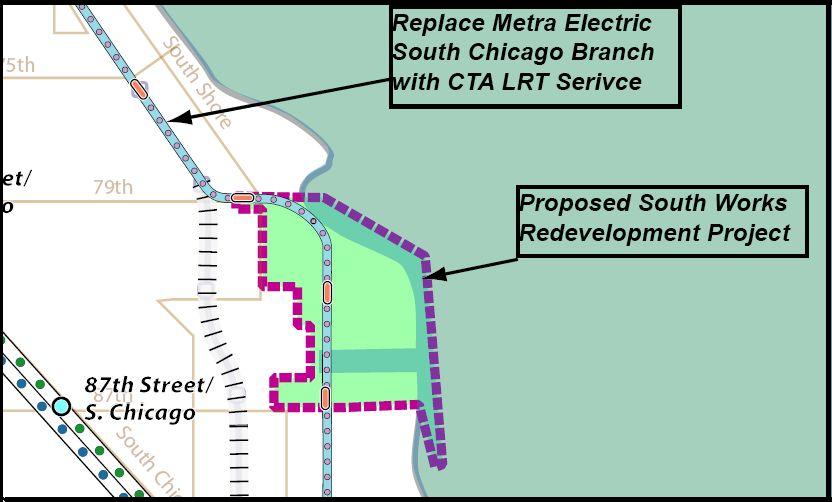
Would South Works  (and other sites like it) continue to languish without the injection of private sector investment? And should we be swayed from our long-term goals of neighborhood-strengthening by the need to address short-term calamities, such as the recent layoff of 1,100 CTA employees?

More specifically, what types of investment should we finance in South Works for the greatest positive impact, and what is the time frame for a program of this magnitude to mature? What opportunities avail themselves?

What about high-capacity transit to service the new urban neighborhood? This blog has long advocated a Vision Plan for Chicago transit that looks 25, even 50 to 100 years in the future. As the inset (left and above) shows, we might consider securing right-of-way now for a corridor about 1/3 of a mile east of the current Metra Electric South Chicago branch, that can form the mixed-use spine of the new community, while also supporting higher densities than the current line serves. And could the old corridor be repurposed as a new bicycle/pedestrian greenway (not shown) in a neighborhood sorely lacking such facilities?

While we show light rail, this is just a placeholder. Other visions exist for the repurposing of Metra Electric service to better serve the neighborhood, such as the Gray Line proposal. In any case, the community should have a say in the choice of mode, via an inclusive and participatory environmental process that looks at the larger neighborhood comprising South Works plus the existing neighborhoods to the west, all the way to South Chicago Avenue, not just the new neighborhood being slapped on the landscape.

The point is not to fall in love with any single plan, but to look thoughtfully and holistically at the myriad of elements needed to create a truly great, new neighborhood that supports and strengthens its surroundings and brings social and economic vitality to an entire chunk of a great city, in this case southeastern Chicago. We don't get these kind of chances often, so let's go about getting to these decisions the right way.

Thursday, May 27, 2010

Sweden's Newest Rail Transport Revolution

From its inception, Sweden's railroad system defied trends. Construction began on this vast nation’s first rail line in the 1850's and from the outset an coordinated decision was made to keep major lines inland, avoiding the coasts as a defensive measure to protect rail lines from the threat of military attacks. This decision also kept the railroads out of direct competition with established steam boat routes along the coast. As a result, the inland rail lines flourished and paved the way for what is now the 20th largest railroad network in the world, providing nearly full geographic coverage to an area of roughly 175,000 square miles, or slightly larger than California.

For decades to follow, Sweden allowed private companies to build additional rail lines in order to maintain a competitive rail industry. Until the era of the Great Depression, the rails were still owned in part by private parties. As was true in much of the world, with the rise of the automobile came the decline in passenger rail transportation, though Sweden remained proactive about maintaining and expanding their rail system. In the 1980's Sweden instituted controversial changes to managing its railways by separating train operations from rail infrastructure management. Coupled with the introduction of high speed trains in the 1990's, a streamlined ticketing system, and the much-publicized introduction of biofuel engines; the Swedish rail system continued to sustain itself as a viable mode of transportation into the 21st century.

As of early 2010, Sweden is yet again revolutionizing organization of its transport systems. One of the system's early founders, former Director-General of Swedish State Railways Bengt Furback, always held a strong belief that the government should treat road and rail equally. In turn, the government created a national rail authority and national roads administration. But now, the powers that be in Sweden no longer see the benefit of separate agencies. As of April 1st, 2010, authorities have combined these two authorities into a new agency, the Trafikverket, and added to its purvue the oversight all sea ports and airports. The planning and management of virtually all modes of transportation in Sweden have effectively been merged into one agency.

Opponents of the reorganization remain staunch advocates for the traditional vertical integration of rail systems, but the Swedish government believes the move will better prioritize allocation of money across all transit modes. Considering the vast technical disparities between these four major modes of transportation and variations in traffic control and management, oversight of the Trafikverket seems a daunting task from a practical standpoint. If Sweden overcomes the challenges at hand and succeeds in their transportation experiment, it will be interesting to see if other countries follow suit.

Particularly in America, which is in the throes of rethinking its own national rail strategy, it would be interesting to try and glean something from the experiences of other nations who have “been there”, even if the realities of politics and economics differ tremendously between the two countries. As always, your thoughts and further comments are appreciated.

[Photo of Oresund Road/Rail Bridge/Tunnel connecting Sweden with Denmark courtesy of www.wonderfulinfo.com]

Monday, May 10, 2010

The Obama Infrastructure Plan, Year 2

On February 17th, 2009, President Obama countered the recession with his own economic stimulus plan: The American Recovery and Reinvestment Act (ARRA). Proponents of public transportation heralded the effort, which allocated over $48 billion of the $787 billion economic stimulus package towards infrastructure improvements.  These investments into our nation's infrastructure focused on of a range of transportation initiatives including highway, rail, air and maritime. When the Act was first unveiled, its primary goals were threefold: to rescue, recover and reinvest. Long term benefits were intended to materialize through improvements in the efficiency of transportation systems across America and increasing our economic viability internationally. More immediate goals of the plan primarily came down to creating jobs. The Obama administration cited the lofty but vague goal of creating ‘millions of jobs’, both direct and indirect. Due to the long-lead nature of construction projects, it was speculated that the bulk of new jobs wouldn't be created until mid-2010. As we're nearing that milestone, it seems an opportune time to reflect on what the large-scale infrastructure plan has and has not accomplished early in its sophomore year.

To start, let's talk money. How much of the money has been awarded? How many projects have received money and commenced construction? Within days of ARRA’s passage, money was being awarded. Within six months $33.2 billion had been awarded to states for proposed projects and of that, $20.6 billion had been committed to specific projects readying them to begin construction. The push to award funds was immense right after ARRA passed, then slowed appreciably in following months. As of April 30th, 2010, just over $39 billion had been awarded. Of that, less than one-third of funds, or $10.9 billion, has been received by states to begin projects. This equates to just over one-fifth of the total stimulus money allocated for infrastructure improvements currently being used to fund actual projects. While a $10.9 billion is a large injection into our nation's neglected infrastructure, the task at hand remains large. Let's hope that projects gain approval and funding is doled out with renewed ferocity in this second year.

Let's address the major short-term goal of the infrastructure plan, job creation. The Obama administration attempted complete transparency in job reporting, which proved to be a difficult task. Early reports in 2009 claimed that over one million jobs had been created within months of the act being passed. In fact the White House claimed that public and private forecasters estimated the Recovery Act was 'responsible' for 2 million jobs in its first year. The administration later admitted challenges in quantifying the number of jobs 'saved or created' by the Recovery Act and changed their terminology altogether to 'jobs funded by the recovery act'. Early numbers were revised and it was determined that from February 17th to September 30th, 2009, 633,376 jobs were funded by the Recovery Act. From last October 1st through the end of 2009, 608,311 jobs were funded by the Recovery Act and in the first quarter of 2010, 682,779 jobs were funded by the Recovery Act. While the numbers aren't as astonishing as what was first reported, the increase in job creation in 2010 is a reassuring trend. Could this be a leading indicator, demonstrating that we're on the verge of seeing the funded infrastructure projects go into full swing?

What are your thoughts?

Tuesday, March 23, 2010

Public Works Infrastructure and Recessionary Finance

The Depression-era WPA building program left many iconic and enduring projects in place , even while putting people to work during the job-starved 1930s. Landmarks and structures such as public buildings, post offices, major bridges, dams, zoos and many others went up in a relatively brief period, and are still utilized and enjoyed by tens of millions today.

President Barack Obama’s multi-billion dollar federal stimulus package has not yet proposed a similar visionary program, instead focusing on “shovel-ready” projects, which typically translate into short-term fixes such as road repaving projects. This is even though taxpayers would be getting as much as 30% more for their money due to the favorable bidding environment (compared to pre-recessionary times).

Of course the type of planning needed requires a long-term vision which, in the arena of national politics and partisan bickering, is not necessarily the expedient route. Some cities such as San Diego have recognized this and are focusing on longer horizon projects entailing major transit/highway expansion or rehabilitation, with life spans of 50-year or longer. Schenectady, New York Mayor Brian Stratton, echoing the position of the U.S. Conference of Mayors, has been pushing a re-creation of the FDR-era WPA program, though his focus has been on funneling federal stimulus funds directly to local governments.

Despite the difference in these emergent approaches, there seems to be a general recognition that the first round of stimulus funding was not very effective. Aligning the true needs of our nation’s infrastructure to the Obama Administration’s vision for creating jobs seems the greatest challenge to overcome.

In our mind, the real question is this: if we’re spending money we don’t have anyways, why not spend it on projects with long-term value? And on a “touchier” note, at what level of government is “value” determined, when it comes to apportionment of federal tax dollars? Is it time to appoint a new “infrastructure czar” to work the interstices of federal/local politics, perhaps backed up by a nationwide cabinet of transit and public works officials? This panel could be given the authority needed to short-circuit the evaluation of projects, as well as to distribute stimulus funds, cutting through the red tape now hampering the process. This would be for the greater good of our nation in the short term, as well as our long-term economic prospects.

My fingers are limber. Who do we email??

As always, thoughts and comments are appreciated!